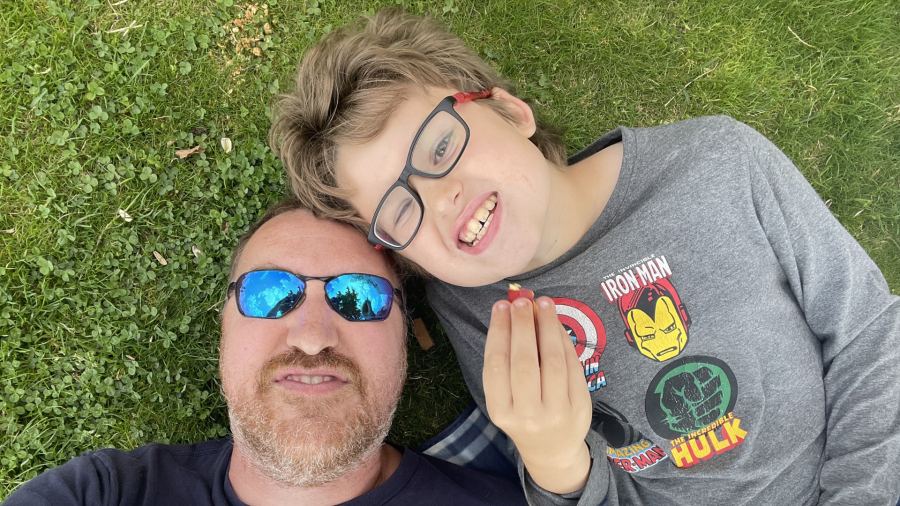
I have a confession to make – I think I’m a bad parent.
Now, I don’t know any parent who hasn’t had this thought on many occasions as their kids grow up. But the difference here is that my reasoning is simply because I am a disabled dad of a disabled child.
We have two wonderful kids, one who has grown up to be an amazing young woman. She is compassionate, caring, and hard-working. After struggling to find her way at university, she ended up finishing early and, following a tough few months trying to find work, she chanced upon her current job at an assisted living home.
Although things were tough growing up, as Kath and I were very young and had very little money, we always made sure she got what she wanted – even if we had to be quite creative at times in how we did it. She may have had to make do with my old hand-me-down laptop or a second-hand ballet outfit (we don’t really mind that, as she only lasted a term), but the point was that she didn’t miss out.
Between Kath and me, we tried to take equal responsibility for her parenting, with each of us stepping in when the other had a commitment. All things considered, I think it went as well as it could.
Our youngest is a real character, and it became clear from a young age that he had some additional needs. Being from a slightly neuro-spicy family – I put a lot of this down to my own quirks – and my self-imposed ableism resisted a lot of the evidence and advice, putting it down to something he would adapt to and that would become his strength, but William’s autism and ADHD are also his greatest challenges.
I realise now how wrong this internalised ableism really was and now, alongside Kath, I am his biggest advocates in ensuring he has the best support available. There is a lot of self-berating for my former position, but that isn’t why I have my parenting doubts.
During school holidays, Kath will take most of the lead in ensuring childcare cover, and I endeavour to step in and fill the gaps when she has to see clients. In the past, on those days, we would go and see family, take a trip to the shops, the cinema, and so forth. But all that changed six years ago when I was registered blind.
After that, the trips to see Mum in the country became all but impossible, with no public transport available to get to hers from the local train station. Even a simple bus trip into town became a challenge when my sight loss is combined with his stimming. The last solo trip we took to the cinema was about three years ago and almost resulted in a full-scale manhunt after he wandered off while I was tidying away our dinner after the film. Since then, our solo trips have become limited to a walk to the local café for a glass of milk and a millionaire’s shortbread, or a home movie day.
The difficulty is that, as a disabled parent of a disabled child, there is very little I can do without needing to enlist external support. There’s even a question as to whether the local cinema would allow me to take him to a show alone.
Disabled people are entitled to a free assistant ticket to the cinema so long as we have a valid CEA card. This goes alongside the Blue Badge we have for parking, the Access Card we have for going to gigs and tourist attractions, the National Trust companion card, the disabled bus pass, disabled railcard, and I don’t know how many other proofs I have to evidence my disability. The irony is the cost of all these cards and their regular renewal goes a long way to overriding the discounts they are supposed to unlock.
It does beg the question though: if there are two people going to see a film, both of whom have a CEA card, does that mean we are classed as each other’s carers and can both go for free?
Anyway, back to the topic at hand. Not so long ago, William asked if I could take him to the LEGO store in Picadilly Circus and, yet again, I had to say no. We could probably have navigated the trains with assistance, but walking down a busy Oxford Street when he has a tendency to get distracted, means the risk of us losing sight of each other is simply too great to contemplate a trip like this without support.
And this is the real problem as a disabled parent.
Even before you account for the additional expense of transport and so forth, you simply cannot get away from the fact that most of the things an able-bodied parent takes for granted just aren’t possible without external involvement.
For a simple trip to see a film, we first need to consider how best to get there. I usually catch the bus, but William insists on going upstairs which I cannot do. Likewise, he gets overwhelmed with all the noise, so he needs his headphones, meaning a bus trip can push us to the brink even before we start our day out.
The best option really is a taxi, but even ignoring the additional £40 a two-way trip to Reading and back will cost me, that also must be managed carefully. For example, I tend to avoid a popular ride-hailing app if I can because, despite the Equality Act, many drivers are notoriously funny when it comes to assistance dogs, so I stick to one or two local, trusted taxi companies.
Once in town, the first job is to sort lunch, which is typically a quick meal from a well-known chain with golden arches. Like all places, self-service is the name of the game, meaning this blind bloke must navigate an inaccessible touchscreen. For this, I have my tech support, who is a dab hand at these, and after what seems like just a couple of seconds of swiping his hand across the screen, we have his nuggets and my wrap, and then we’re off to find a table to wait for our order.
Afterwards comes the first danger point: handling a guide dog to the cleaning area whilst precariously holding a tray in the other hand and trying to keep tabs on William’s location. For this we are heavily reliant on the kindness of others, and are lucky that often a member of staff or another customer will offer to help with the tray. I do try to get William to take some responsibility for tidying up if he is in the right place.
After successfully navigating lunch, we’re off to the cinema. Timing here is key as William insists on being sat in his chair at least 5 minutes before the scheduled start time because he doesn’t want to miss a single advert or trailer.
Before we go in, there is the small matter of collecting headphones for the audio description. This can prove challenging depending on who is around, as in my experience, many more junior staff members are not aware of where the headphones are or how they work.
We try to get a seat on the aisle, as it is just easier if William needs a movement break during the showing, and it gives some more space for Chester to lay on his blanket. The dog can be a bit unsettled at first, but once the lights go down, he will sprawl out to sleep.
Now, movies can get overwhelming for William, especially the first time he’s seen one, and he can need either a few movement breaks or a trip or two to the loo. He can be trusted to take himself, but the nerves kick in until I hear him coming back into the theatre and retaking his seat.
So you see, once we’ve got a cab home, all of us are exhausted and need some time alone in a dark room (with a beer or two for me). This is the state of play for a disabled parent of a disabled child – a simple trip to the supermarket can end in sensory meltdown for one, the other, or both of us.
This is even without the mutterings and comments we get – especially when William starts to stim in the middle of the frozen aisle because the fans on the chillers are exceptionally loud that day. And don’t get me started on all the people who insist on petting Chester when he is quite clearly on duty.
It frustrates me so much that, despite there being much more awareness of neurodivergence, there remains a huge stigma when someone outwardly displays their tics in public. It’s wrong just how many times either Kath or I have had to step in to defend our son simply for being himself.
It really is no wonder I often opt for the path of least resistance and stay home. I’d love to go to all the places we used to, but it just isn’t possible. The logistics, planning, and costs simply outweigh everything else.
And so I’m back to beating myself up and missing out on so many key moments. Perhaps I’m being overly cautious, but there have been far too many times when I’ve lost sight of him and he hasn’t responded to my calls (and that’s when others are around), so I just don’t feel like I can take the risk alone any more.
Hearing the disappointment in his voice each time I say “no” snaps another heartstring, and really, I need to stop listening to my internal ableist demon and start finding ways to adapt and ask for help more.
The impact on our relationship is too great to stick with the status quo, so something needs to change. There is a lot of practical support available for us individually, but nothing to bring these both together which would make a real difference to both of our lives.
And is there really anything wrong with doing these things with external help if that means we both benefit?
 Blind Man with a Backpack
Thanks for sharing this Chris.
You already know this, you aren’t a bad parent.
However, I do understand why you feel like that. The need to say no, the constant challenges and then over time the fact my kids now just go to their mum and assume I will say no/can’t.
It is hard, but we are good parents.
LikeLike